For most of its life the sky was a document about the king. It became a document about you fairly late, by accident, and for bureaucratic reasons.
That is the part the modern horoscope hides. A sun-sign column looks like a folk belief that was always there. It is instead the surviving fragment of a technical system that was built by court scholars, carried across three empires, translated twice, and then reduced in 1930 to the one variable a newspaper could print for everyone.
The rest of this post is that history, and then what the system actually specifies: the frames, the arithmetic, the defaults its practitioners argue about, and the tests that settled whether any of it predicts anything. If a word gets in the way, there is a plain-language glossary of every term just before the technical half.
The short version The sky spent its first two thousand years as a warning system for a king. Babylon cut it into twelve signs for arithmetic convenience, Alexandria wrote the reading rules, Rome banned and hired it, Baghdad copied it, and a 1930 newspaper kept the sun sign. What survives is a specification: two coordinate frames, one set of formulas, several undisclosed defaults, and no measurable predictive effect.
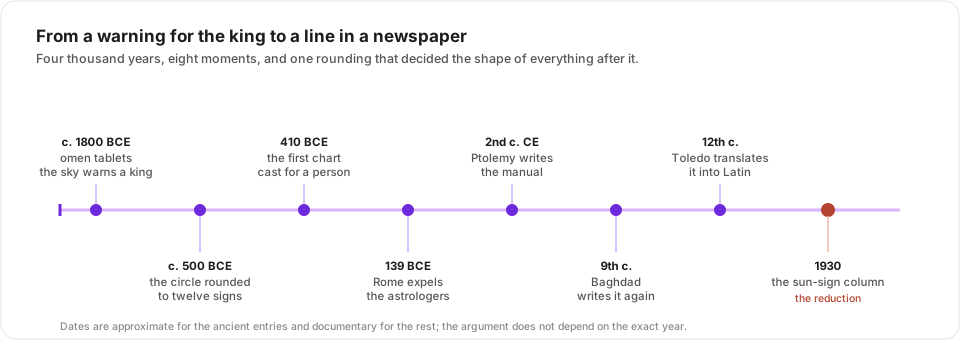
Four thousand years in eight moments: the red dot is the one that reduced the system to a single number
The sky as a state document
Babylonian scholars watched the sky for the king, and they wrote down what they saw as omens. The collection is the Enuma Anu Enlil, seventy tablets of celestial events and their consequences, compiled in the first millennium BCE from material centuries older [1]. A lunar eclipse was not about your week. It was about the throne, the harvest, the army, and whether the state would survive the year.
The logic was the same one that produced liver omens and bird omens: a rare event is a message, and the job of the scholar is to know which message. Celestial divination was not astrology yet, because there was no chart and no individual. There was a sign, and there was a king who had to be warned.
A circle rounded to twelve
Around the fifth century BCE, Babylonian astronomers did something that turned out to be the most consequential rounding in the history of the subject. They divided the ecliptic into twelve equal sectors of 30 degrees and named each one after a constellation it roughly covered [3].
The reason was arithmetic, not observation. Sixty is a convenient base, twelve divides sixty, and thirty degrees per sign makes every position a number a scribe can write without a table. The constellations themselves are not equal, and they are not twelve: the ecliptic crosses thirteen IAU constellations, and the Sun spends about 18 days in Scorpius against 7 in Cancer’s neighbour [13].
Once the sky has coordinates, it can be computed, and once it can be computed it can be computed for anybody. The oldest surviving personal horoscope is a cuneiform tablet from Babylon dated 410 to 409 BCE [2]. Someone took the omen logic that had been pointed at the king and pointed it at a birth moment. The individual reading is younger than the state reading, which is worth remembering the next time someone says astrology has always been about personality.
Alexandria writes the grammar
The system as it is practiced today was assembled in the Hellenistic world, in Greek, over the last centuries BCE and the first centuries CE. Ptolemy’s Tetrabiblos, in the second century CE, is the surviving manual: signs, planets, houses, aspects, and the rule that a position is read from what the body wants, in the manner of the sign, in the field of the house [4].
That grammar has not changed in eighteen hundred years. It is why a modern book and a papyrus fragment can describe the same chart, and it is also why the disagreements are so stable: the grammar is fixed, and everything contested afterwards is a default.
Ptolemy is also the reason to be careful with the word “belief”. He wrote as a natural philosopher, arguing that the influence of the heavens is real but weak, and that its study is subordinate to astronomy, which supplies the positions. The technical framing was there from the start.
Banned in public, employed in private
Rome is where the pattern that still holds becomes visible. In 139 BCE the praetor Gnaeus Cornelius Hispallus had the Chaldaeans expelled from the city and ordered out of Italy within ten days, and they were expelled again in 33 BCE [5]. The same sources record that Augustus was born under Capricorn, made his horoscope public, and put the sign on coins, and that Tiberius kept an astrologer, Thrasyllus, close enough to be consulted about succession [5].
Expelled in public, employed in private. Every later century repeats the arrangement, including the one where a newspaper prints a column and a technology company runs a horoscope API.
The route east, and the route back
The system survived by travelling. Greek material reached India as the Yavanajataka, a Sanskrit work of the second or third century CE, which is the point where the Greek vocabulary enters Indian astronomy [6]. It reached Baghdad in the eighth and ninth centuries, where Abu Ma’shar wrote the manuals that later Latin Europe learned from [7]. It came back into Europe through the twelfth-century translations in Toledo, and from there into the medieval university curriculum, which is why Chaucer could write a treatise on the astrolabe for his son.
None of this is a straight line, and none of it is a secret. The system is a chain of translations, and each translation carried the same table of signs with a slightly different set of defaults attached.
The other route, the one that reached Vietnam
The route that matters for the Vietnamese reference this post started from is separate, and it runs through the calendar rather than through the sky.
The sexagenary cycle is a counting system, sixty year names made from ten stems against twelve branches, and it came east with the administrative calendar [20]. It does not need a position in the sky. It needs a date, and the machinery to convert that date into a lunar year, which is exactly what a calendar office existed to do.
Zi Wei Dou Shu, tử vi in Vietnamese, is the personal chart built on top of that calendar. It is traditionally attributed to the Song dynasty figure Chen Tuan, and it is a calculational system: twelve palaces, fourteen principal stars, all placed from the lunar birth date, the hour, and the sex [8]. It does not observe anything. It computes.
So a Vietnamese reader meets two systems with almost nothing in common except a shared assumption that dates carry meaning. One reads planets on the ecliptic and needs a birth minute. The other reads a calendar and needs a birth year. The document I started from contains both, which is why it has two halves that do not share a vocabulary.
1930: the newspaper throws away the system
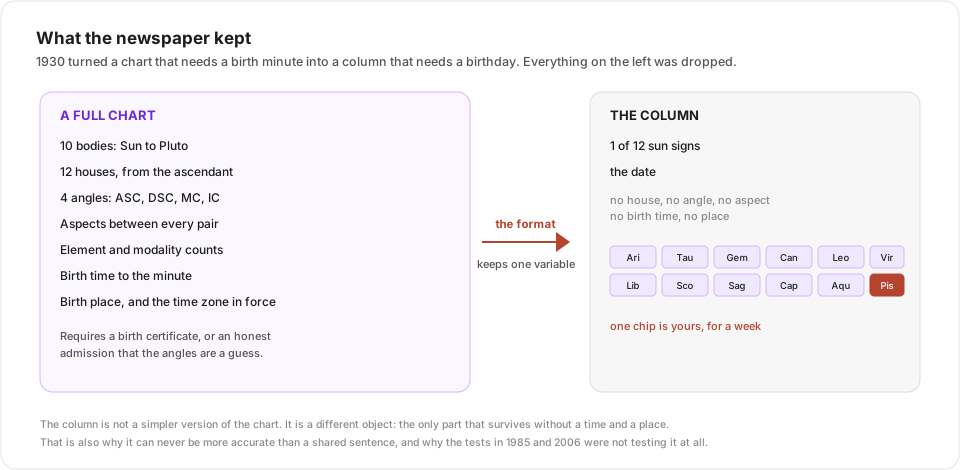
What the 1930 format kept: one variable out of a system that had needed a birth minute to work at all
Modern popular astrology starts with a story assignment. In August 1930 the Sunday Express wanted something for the birth of Princess Margaret, the astrologer R. H. Naylor produced a forecast, and the paper discovered that readers wanted more of it. The sun-sign column followed, and it is still the format [9].
That format throws away almost everything the system contains. A full chart needs ten bodies, twelve houses, the aspects between them, and the four angles, which together need a birth date, a birth time to the minute, and a birth place. A sun-sign column needs the date. It keeps the one variable that can be printed for everybody, and it discards the frames, the houses, the angles, and every reason the system ever had for demanding precision.
Everything people mean by “astrology” today is that fragment. The rest of this post is about the rest of the machine, because the machine is the interesting object: it is a specification, and specifications have versions.
What the reduction cost A full chart needs a date, a minute, and a place. A column needs a date. The 1930 format kept the smallest possible part and discarded everything that made the rest computable, which is why two people arguing about astrology rarely agree on what they are arguing about.
Words this post uses
Skip this table if the vocabulary is already familiar. It is here so the rest of the page never has to stop and explain a word in the middle of an argument.
| Word | What it means on this page |
|---|---|
| ecliptic | the Sun’s yearly path across the sky, and the road the planets stay close to |
| zodiac | that path cut into twelve equal slices of 30 degrees, each named after a constellation |
| tropical zodiac | slices measured from the spring equinox, the convention Western astrology inherited |
| sidereal zodiac | slices measured against the stars, the convention Vedic astrology uses |
| equinox | the March moment when day and night are equal and the Sun crosses the celestial equator |
| precession | the slow wobble of the Earth’s axis, which drags the equinox backwards by 50.29″ a year |
| ayanamsa | the measured gap between those two zero points, 24°13′ in 2026 |
| constellation | a group of stars as astronomers draw the boundary, uneven in size, thirteen of them on the ecliptic |
| natal chart | a map of where the bodies were at the moment and place of a birth |
| body | in astrology, the Sun and the Moon count as planets; there are ten in all |
| house | one of twelve slices of the day, each standing for an area of life |
| ascendant | the degree rising on the eastern horizon at the birth minute |
| midheaven | the degree highest in the sky at that same moment |
| aspect | an angle between two bodies that the reading treats as a relationship |
| ephemeris | a table or library that says where each body is at a given time |
| orb | how far an angle may drift and still be counted as an aspect |
| can chi | the sixty-year cycle built from ten stems and twelve branches |
| nạp âm | the element attached to each year of that cycle |
| cung phi | a number from birth year and sex that sorts a person into one of eight groups |
| canh giờ | the twelve two-hour blocks of the Vietnamese day |
Two zero points
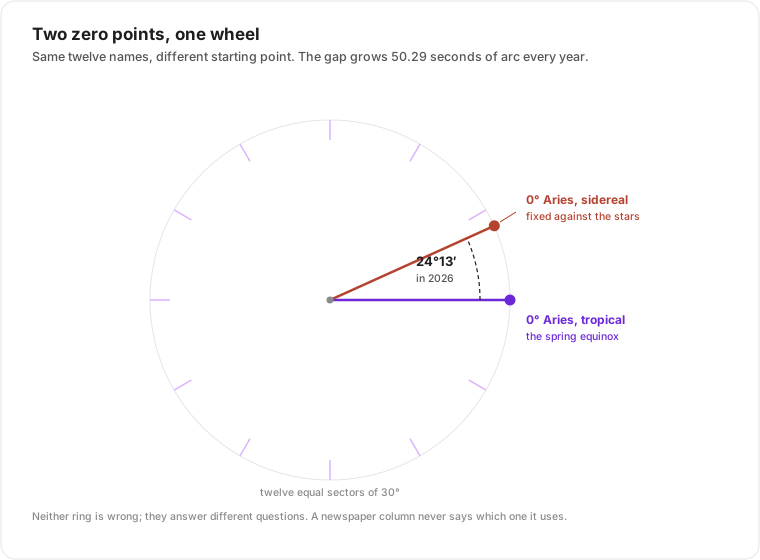
The same twelve names, two starting points, 24°13′ apart in 2026 and separating a little every year
Western astrology uses the tropical zodiac: 0° Aries is the vernal equinox, the point where the Sun crosses the celestial equator in March. The twelve signs are equal 30° sectors measured from that point, the fifth-century convention described above, not the constellations [3].
The Vedic tradition uses a sidereal zodiac, fixed against the stars. The difference between the two zero points is the ayanamsa, and it grows because the equinox moves: axial precession carries it backwards along the ecliptic at 50.29 arcseconds a year, one degree every 71.6 years [11].
The arithmetic is worth doing once:
- precession rate: 50.29″ per year
- since the Lahiri zero point, roughly 1,700 years have passed
- 1,700 × 50.29″ = 85,493″ = 23.7°
The commonly published Lahiri offset for 2026 is about 24°13′, the same number arrived at more carefully [12]. So a Sun at 10° Taurus tropically sits at roughly 15° Aries sidereally, and a person born on 20 May is a Taurus to one system and an Aries to the other. Neither is lying. They are reporting different coordinate systems, and the document names the system, which is more than the newspaper column does.
The same precession explains the argument that resurfaces every few years. The Babylonian twelve were drawn against the sky of the fifth century BCE. Two thousand years later the signs have drifted about 29° from the constellations they were named for, and the ecliptic now crosses thirteen constellations instead of twelve [13]. NASA never changed the zodiac, because the zodiac is a convention and not a measurement [13].
The chart is a tuple
Every chart is the same five-layer object. The document states the reading rule in one line: a position is read as planet (what) + sign (in how) + house (where in life), then the aspects between planets, then the four angles [4].
| Layer | Answers | Changes with |
|---|---|---|
| Body | what kind of energy: identity, feeling, thought, desire, action | birth date, mostly |
| Sign | in what manner | birth date, except the Moon |
| House | where in life it plays out | birth time and place |
| Aspects | which parts of the chart talk to each other | birth date, plus time for the Moon |
| Angles | the frame itself: ASC, DSC, MC, IC | birth time, to the minute |
The twelve signs are a 3×4 grid, and the grid is the actual content: four elements, three modalities.
| Cardinal | Fixed | Mutable | |
|---|---|---|---|
| Fire | Aries | Leo | Sagittarius |
| Earth | Capricorn | Taurus | Virgo |
| Air | Libra | Aquarius | Gemini |
| Water | Cancer | Scorpio | Pisces |
Two properties follow from the grid without any interpretation. A chart’s element count comes from the personal planets plus the ascendant, so a chart heavy in one element says where the energy is. And empty houses are normal, because ten bodies cannot fill twelve houses: everyone has at least two empty, and four to six is typical [15]. The house is not dead when empty; you read it through the ruler of its sign, which points at the house the ruler occupies. That rule is the single most useful thing in the document, because it converts “nothing there” into “look elsewhere”.
The arithmetic, and what it costs
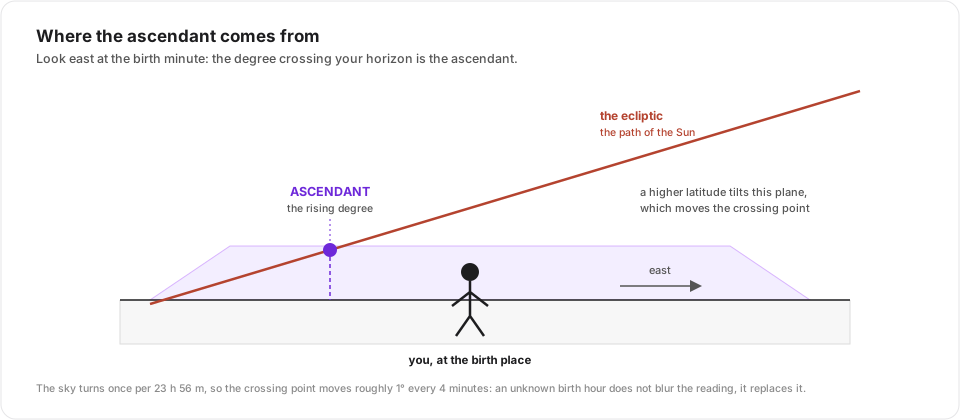
The ascendant is not a body, it is an intersection: where the ecliptic meets your eastern horizon at your birth minute
Planet positions come from an ephemeris. The Swiss Ephemeris is the standard open one, built on JPL’s DE431 and accurate enough that the limiting factor is your birth time, not the theory [10]. The angles do not need a planet at all; they are spherical trigonometry on the local meridian.
Let \(\theta\) be Greenwich mean sidereal time in degrees, \(\lambda\) the birth longitude (east positive), \(\varepsilon\) the obliquity, \(\varphi\) the birth latitude. Then the right ascension of the meridian is \(\mathrm{RAMC} = \theta + \lambda\), and
$$ \mathrm{MC} = \operatorname{atan2}\left(\sin \mathrm{RAMC},\ \cos \mathrm{RAMC}\cos\varepsilon\right) $$$$ \mathrm{ASC} = \operatorname{atan2}\left(\cos \mathrm{RAMC},\ -\!\left(\sin \mathrm{RAMC}\cos\varepsilon + \tan\varphi\sin\varepsilon\right)\right) $$Both need the quadrant-correct atan2, and both are in degrees. The mean sidereal time is a polynomial in
the Julian centuries since J2000, and the obliquity is \(\varepsilon \approx 23.4392911° - 0.0130042°\,T\).
import math

def jd_utc(y, m, d, hh=0, mm=0, ss=0):
    if m <= 2:
        y, m = y - 1, m + 12
    a = y // 100
    b = 2 - a + a // 4
    return (math.floor(365.25 * (y + 4716)) + math.floor(30.6001 * (m + 1))
            + d + b - 1524.5 + (hh + mm / 60 + ss / 3600) / 24)

def gmst(jd):
    t = (jd - 2451545.0) / 36525.0
    return (280.46061837 + 360.98564736629 * (jd - 2451545.0)
            + 0.000387933 * t * t - t ** 3 / 38710000.0) % 360

def obliquity(jd):
    t = (jd - 2451545.0) / 36525.0
    return 23.4392911 - 0.0130042 * t - 1.64e-7 * t * t

def angles(jd, lat, lon):
    ramc = (gmst(jd) + lon) % 360
    e, p, r = map(math.radians, (obliquity(jd), lat, ramc))
    asc = math.degrees(math.atan2(math.cos(r),
                                  -(math.sin(r) * math.cos(e) + math.tan(p) * math.sin(e)))) % 360
    mc = math.degrees(math.atan2(math.sin(r), math.cos(r) * math.cos(e))) % 360
    return asc, mc
Checked two ways, because a formula that looks right and is wrong by a quadrant is worse than no formula. The sidereal time term matches PyEphem’s apparent sidereal time to within 3.6 arcseconds on a test date, which is 0.24 seconds of clock time [14]. Feeding the computed ascendant longitude back into an ephemeris as a fixed body puts it on the horizon at altitude 0.14°, in the eastern half of the sky, which is the definition of the ascendant. The residual comes from using the mean obliquity; an ephemeris handles it properly.
The sensitivity is where the real engineering problem lives. Birth date is enough for the slow planets. Birth time is not optional, because the angles turn at the sky’s rate: 360° per 23h56m, about one degree every four minutes. Birth place shifts the ascendant by a few degrees between cities in the same time zone, and time zone conversion, including historical daylight saving, shifts it by whole degrees. The Moon moves 13.2° a day, so an unknown hour can move it between signs.
| Input | What it determines | What goes wrong without it |
|---|---|---|
| date | Sun to Pluto, most aspects | nothing, mostly |
| time | ASC, MC, all twelve houses, Moon sign | the chart is not yours, it is a plausible relative |
| place | small ASC shift | borderline degrees flip |
| timezone | whole degrees of every house | silent, and the most common error |
Undocumented defaults
Most practitioner disagreement is not about astronomy. It is about defaults that the document makes explicit and the popular versions do not.
| Default | Options | Consequence |
|---|---|---|
| House system | Whole Sign, Placidus, equal | a planet before the ASC in the same sign sits in house 1 or house 12 depending on the choice [15] |
| Ayanamsa | Lahiri, Raman, KP | every sidereal position shifts by about a degree between systems |
| Orbs | 3° to 10° by aspect | which aspects exist at all |
| Dignities | traditional rulers versus modern co-rulers | Scorpio ruled by Mars or Pluto changes the reading |
| Nạp âm | traditional exceptions | a Fire year that behaves like water |
A specification that does not name its defaults is not a specification, it is a mood. The document names them, and that is the difference between it and a horoscope column. It is also why two competent astrologers can produce different readings from the same birth data without either of them lying.
What the tests settled
The interpretive layer has been tested repeatedly, and the results are consistent.
What the evidence says The same reading fits everyone, astrologers match charts at chance even on easy traits, and 15,000 people show no effect of birth date on personality or ability. The four studies below are why the empirical question is not open.
Forer, 1949. Thirty-nine students took a personality test and received an individual vignette. Every vignette was identical, thirteen generic sentences. Almost all students rated it as an accurate description of themselves [16]. This is the Barnum effect: vague statements feel personal because the reader supplies the specifics. It is not a flaw in astrology specifically; it is a flaw in how people read any description of themselves.
Carlson, 1985. A double-blind test published in Nature, designed with astrologers so that they could not call it unfair. They set their own bar: the astrological hypothesis would be supported if they matched charts to personality profiles at 50 percent in both parts of the test [17]. They achieved 0.34 on the first part against a chance expectation of 0.33. On the second part, with pre-marked profiles, 0.446 against 0.200 for the control group, still below their own threshold. Carlson’s conclusion was that the results were consistent with chance, and the paper closed with a note that the astrologers had blamed the experiment’s design rather than the theory.
Dean and Kelly, 2003. A review in the Journal of Consciousness Studies, reporting a meta-analysis of more than forty controlled studies: astrologers performed no better than chance even on the simplest task, predicting extraversion, and those claiming psychic ability did no better than those who did not [18]. The same paper reports a large test of people born less than five minutes apart, the strongest possible case for a birth-moment effect, and found no similarity beyond chance. The effect size across the literature is about 0.05, which is close enough to zero to be uninteresting.
Hartmann, Reuter and Nyborg, 2006. Two large samples, 15,000 subjects in total, with measured personality and intelligence rather than self-report. No relationship between date of birth and either. No effect of Sun signs, elements, or astrological gender. Two marginal seasonal effects of less than one IQ point did not survive a correction for the number of tests run [19]. The authors are careful about what this shows: it cannot falsify every astrological claim, because the positions of the other planets were not tested. It can and does falsify the common ones, and the effect sizes are too small to matter even if they were real.
| Claim | Test | Result |
|---|---|---|
| a reading describes this person | Forer 1949 | the same text fits everyone |
| astrologers can match charts to people | Carlson 1985 | 0.34 against 0.33 chance, below their own 0.50 bar |
| astrologers beat chance on simple traits | Dean and Kelly 2003 | no, across forty plus studies |
| birth date shapes personality or ability | Hartmann et al. 2006 | no, across 15,000 people |
What the tests do not settle: whether a chart is a pleasant thing to read, a useful vocabulary for talking about personality, or a cultural practice worth keeping. Those are not empirical questions, and the document is honest about it in its own closing section.
The Vietnamese layer
The second half of the document is a different system with a different input: the lunar year, not the sky at the minute of birth.
The can chi cycle is 60 years, ten heavenly stems against twelve earthly branches [20]. The year changes at Tết, not on 1 January, so anyone born in January or early February needs the lunar date, not the Gregorian one. Each stem-branch pair carries a nạp âm element, which is why two people in the same branch can have different elements. The stem’s polarity sets the direction of the luck cycles, which is why the same chart is read differently for a man and a woman in some schools.
Cung phi, the Eight Mansions number, is pure arithmetic on the lunar birth year and sex. Take the last two digits of the year, sum them, reduce to one digit, call it \(r\). Born before 2000: male \(= 10 - r\), female \(= r + 5\). Born 2000 or later: male \(= 9 - r\), female \(= r + 6\). Reduce again; a result of 5 becomes Kun for a man and Gen for a woman. The number maps to a trigram, and the trigrams split into east and west groups, which is what decides whether two people are compatible under bát trạch [21].
Worked example, a man born in 1990: \(r = 9\), so \(10 - 9 = 1\), Khảm, east group. A woman born in 1990: \(r = 9\), so \(5 + 9 = 14 \to 5\), which becomes Gen, west group. Same year, different group, and that is the entire basis of the compatibility table.
The canh giờ are twelve double hours, Tý from 23:00 to 01:00 through Hợi from 21:00 to 23:00, which is the one place where Vietnamese practice maps onto the same 24-hour clock as Western astrology, with the same sensitivity: an uncertain birth hour moves you one canh.
Converting dates is the only part that needs code. Use the Vietnamese lunar algorithm by Hồ Ngọc Đức, which computes new moons and solar longitude and decides leap months by the same rules the calendar bureaucracy uses [22]. Do not reimplement it from a blog post; the leap-month rule has a subtlety that takes an afternoon to find.
Why keep the document
Because a specification that documents its own limits is worth having. The chart gives a shared vocabulary for talking about temperament: “Mars in the twelfth house” is a compressed way to say “anger that does not get expressed”, and that phrase is useful in a conversation even if the astronomy behind it is not.
The document’s own closing section says the same thing. It notes that astrology and tử vi have no scientific basis, that the descriptions are general enough to fit anyone, that schools disagree about everything from house systems to nạp âm exceptions, and that whether two people get along depends on how they treat each other more than on where anything was at the moment they were born.
That is a better end than most textbooks manage. The interesting engineering work is the specification itself: the frames, the arithmetic, the defaults, and the tests. Everything else is a decision about what to do with a system that is computable, internally consistent, and empirically empty.
References
[1] LMU, Enūma Anu Enlil Ištar (EAE 50–68): the electronic Babylonian library edition of the celestial omen series, with its tablet structure and its relation to the earlier omen collections.
[2] Center for Hellenic Studies, Masterpieces of Ancient and Medieval Astrology: the oldest extant horoscope, a cuneiform tablet from Babylon for 410 to 409 BCE.
[3] Wikipedia, Zodiac: the twelve 30° sectors as a Babylonian convention, later anchored to the vernal equinox by the tropical system.
[4] Ptolemy, Tetrabiblos: the second-century manual that fixes the reading grammar of signs, planets, houses and aspects.
[5] William Smith, Astrologia (A Dictionary of Greek and Roman Antiquities, 1875): the 139 BCE edict expelling the Chaldaeans, the repeat in 33 BCE, and Augustus born under Capricorn.
[6] Wikipedia, Yavanajataka: the Sanskrit work of the second or third century CE through which Greek astrological material entered Indian astronomy.
[7] Wikipedia, Astrology in medieval Islam: the Abbasid translation movement, Abu Ma’shar’s manuals, and the route back into Latin Europe through the twelfth-century translators.
[8] Wikipedia, Zi Wei Dou Shu: the twelve palaces and fourteen principal stars, computed from the lunar date, and the traditional attribution to Chen Tuan.
[9] The Independent, The bizarre story behind Princess Margaret and modern horoscopes: the 1930 commission that produced R. H. Naylor’s column and the modern sun-sign format.
[10] Astrodienst, The Swiss Ephemeris: the ephemeris used to compute planetary positions, built on JPL’s DE431, and the reference implementation behind most software in this space.
[11] Wikipedia, Axial precession: the 50.29 arcsecond annual precession that moves the equinox, one degree every 71.6 years.
[12] Astrodienst Astrowiki, Ayanamsha: the offset between the tropical and sidereal zero points, and the systems that define it.
[13] NASA Space Place, Constellations and the Calendar: the thirteen IAU constellations the ecliptic crosses, the unequal spans, and why the twelve-sign zodiac is a convention rather than a description of the sky.
[14] Brandon Rhodes, PyEphem: the independent implementation used here to cross-check mean sidereal time and to place the computed ascendant on the horizon.
[15] Astrodienst Astrowiki, House system: Whole Sign, Placidus and the other divisions, and the cases where the choice moves a planet between houses.
[16] Bertram R. Forer, The fallacy of personal validation: a classroom demonstration of gullibility (Journal of Abnormal and Social Psychology, 44, 1949): thirty-nine students, one identical vignette, almost all rated it accurate.
[17] Shawn Carlson, A double-blind test of astrology (Nature, 318, 1985): the astrologers set a 50 percent threshold, part one scored 0.34 against 0.33 chance, and the paper’s conclusion was negative.
[18] Geoffrey Dean and Ivan W. Kelly, Is astrology relevant to consciousness and psi? (Journal of Consciousness Studies, 10, 2003): meta-analysis of more than forty controlled studies, a test of people born under five minutes apart, and no performance above chance.
[19] Peter Hartmann, Martin Reuter and Helmuth Nyborg, The relationship between date of birth and individual differences in personality and general intelligence (Personality and Individual Differences, 40, 2006): 15,000 subjects, no effect of date of birth, Sun signs, elements, or astrological gender.
[20] Wikipedia, Sexagenary cycle: the sixty-year can chi cycle, the ten stems against twelve branches, and the nạp âm element attached to each pair.
[21] WOFS, How to calculate your Kua number: the Eight Mansions formula, including the year boundary at the lunar new year and the case where the result is five.
[22] Hồ Ngọc Đức, Vietnamese lunar calendar algorithm: the new-moon and solar-longitude method behind most open implementations, including leap-month selection.